The venue should be flat, clean, well-ventilated, and dust-free. There should be at least 6 meters of open space around the tables, and even more for formal matches. Lighting is crucial; it should be bright but not glaring. Lighting requirements: Two sets of 1000W lights per table for snooker. The venue should be able to accommodate 20 competition tables and 6 practice tables. Each table should be surrounded by 2.5-3 meters of open space.
Cue: Cue sticks are mostly made of wood, with ash and maple being the best choices. A cue stick typically weighs 400-520 grams. The length of a cue stick is 140-150 centimeters. A cue stick consists of four parts: the butt, the shaft, the head band, and the tip. The butt has a rubber pad to protect the end of the stick; the head band tightly wraps around the wooden part of the head; and the tip fits snugly against the top of the wooden head. The tip may become damaged after repeated shots; in this case, the damaged tip can be removed and replaced with a new one.
Balls: Billiard balls are mostly made from chemical resins. In 21st-century world billiards tournaments, resin-synthesized crystal balls manufactured in Belgium are generally used. The size and quality of the balls used vary depending on the type of billiards competition.
Billiard Tables
Pocket Billiard Tables
Common pocket billiard tables are 12-foot and 9-foot tables.
Billiard billiards, Russian billiards, snooker, and other rules primarily use 12-foot pocket billiard tables. A 12-foot pocket billiard table is approximately 12 feet (365.76 cm) long, 6 feet (182.88 cm) wide, and 85 cm high.
Puzzle, 8-ball billiards, Chinese 107, and other rules primarily use 9-foot pocket billiard tables. A 9-foot pocket billiard table is approximately 9 feet (274.32 cm) long, 4.5 feet (137.16 cm) wide, and 80 cm high.
Carom Billiards Table
Carom billiards is popular in France and some European countries. Various game formats can be played on a carom billiards table, such as three-ball carom, four-ball carom, three-way matches, and zone matches. A carom billiards table is approximately 285 cm long, 156 cm wide, and 80 cm high.
Chalk: Chalk is used in billiards to prevent the cue tip from slipping when hitting the ball and to increase friction between the tip and the ball. It is applied by lightly dusting the tip with chalk; do not apply too much at once.
Cue Bridge: A cue bridge is a billiards tool used when the cue cannot be reached or is inconvenient to use the hand bridge. There are several types, including short cue bridges, long cue bridges, high cue bridges, and tip cue bridges.
Ball Cage
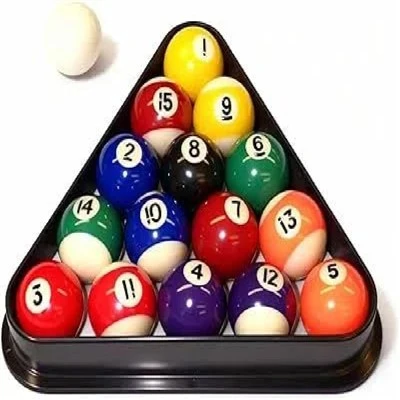
In snooker and American pool, the object balls are positioned using a special triangular ball cage.
Pocketing Device
A pocketing device is a tool used by the referee during a match. When cleaning the balls, the device is used to hold them in place. After cleaning, the balls are returned to their original positions according to the device's markings.