When it comes to the world of billiards, one often overlooks the significance of the billiard triangle. As a billiard triangle supplier, I've witnessed firsthand the intricate relationship between the size of the billiard triangle and the number of balls used in a game. This relationship is not only crucial for the proper setup of a game but also has a profound impact on the overall playing experience.


Understanding the Basics of Billiard Triangles
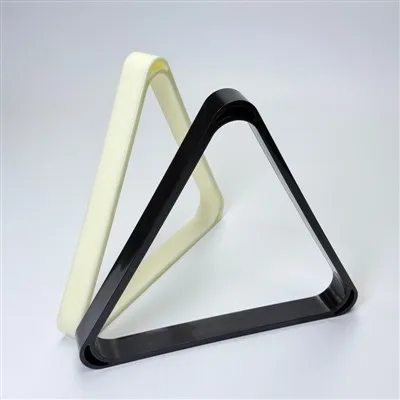
A billiard triangle, also known as a rack, is a tool used to arrange billiard balls in a specific formation at the beginning of a game. The most common types of billiard triangles are made of wood, plastic, or metal. Each material has its own unique characteristics, but the primary function remains the same: to hold the balls in place until the break shot.
The size of a billiard triangle is typically determined by the number of balls it is designed to hold. The most common sizes are the 8-ball triangle, which holds 16 balls (including the cue ball), and the 9-ball triangle, which holds 10 balls. However, there are also triangles available for other games, such as 10-ball, 14.1 continuous, and straight pool.
The Relationship Between Triangle Size and Ball Number
The relationship between the size of the billiard triangle and the number of balls is straightforward: the more balls you have, the larger the triangle needs to be. This is because the balls need to be arranged in a specific pattern within the triangle, and a larger triangle provides more space for the balls to be placed in the correct formation.
For example, in an 8-ball game, the 15 object balls are arranged in a triangle with the 8-ball in the center. The triangle is designed to hold all 15 balls in a tight formation, ensuring that they are evenly spaced and ready for the break shot. If the triangle is too small, the balls may not fit properly, resulting in an uneven break and a less predictable game.
On the other hand, in a 9-ball game, the 9 object balls are arranged in a diamond shape, with the 1-ball at the front and the 9-ball at the center. The triangle used for a 9-ball game is smaller than the one used for an 8-ball game, as it only needs to hold 9 balls. This smaller triangle allows for a more compact and precise arrangement of the balls, which can lead to a more strategic and exciting game.
The Importance of Choosing the Right Triangle Size
Choosing the right triangle size is essential for ensuring a fair and enjoyable game of billiards. If the triangle is too small, the balls may not fit properly, leading to an uneven break and a less predictable game. On the other hand, if the triangle is too large, the balls may be too spread out, making it difficult to achieve a good break and increasing the likelihood of scratching.
As a billiard triangle supplier, I recommend that players choose a triangle that is specifically designed for the game they are playing. This will ensure that the balls are arranged in the correct formation and that the game is played under fair and consistent conditions.
The Impact of Triangle Size on the Break Shot
The break shot is one of the most important shots in a game of billiards, as it sets the tone for the rest of the game. The size of the billiard triangle can have a significant impact on the break shot, as it affects the way the balls are arranged and the amount of force that can be applied to them.
In general, a larger triangle allows for a more powerful break shot, as the balls are more spread out and can be hit with greater force. However, a larger triangle also makes it more difficult to control the direction of the balls, as they are more likely to scatter in different directions.
On the other hand, a smaller triangle allows for a more precise break shot, as the balls are more tightly packed and can be hit with greater accuracy. However, a smaller triangle also limits the amount of force that can be applied to the balls, as they are more likely to be compressed and lose energy.
The Role of Triangle Material in the Game
In addition to the size of the billiard triangle, the material it is made of can also have an impact on the game. Different materials have different properties, such as hardness, durability, and friction, which can affect the way the balls roll and interact with each other.
For example, a wooden triangle is typically more durable and provides a smooth surface for the balls to roll on. However, it can also be more expensive and may require more maintenance than other materials. A plastic triangle, on the other hand, is lightweight and affordable, but it may not be as durable as a wooden triangle.
As a billiard triangle supplier, I offer a variety of triangles made from different materials to meet the needs of different players. Whether you prefer a wooden triangle for its durability or a plastic triangle for its affordability, I have the perfect triangle for you.
Conclusion
In conclusion, the relationship between the size of the billiard triangle and the number of balls is an important factor to consider when playing a game of billiards. Choosing the right triangle size and material can have a significant impact on the game, from the break shot to the overall playing experience.
As a billiard triangle supplier, I am committed to providing high-quality triangles that are designed to meet the needs of players of all skill levels. Whether you are a professional player or a casual enthusiast, I have the perfect triangle for you.
If you are interested in purchasing a billiard triangle, please visit our website at Plastic Triangle Rack to view our selection of triangles and place an order. Our team of experts is available to answer any questions you may have and to help you choose the right triangle for your needs.
References
- Byrne, R. G. (1990). Standard Book of Pool and Billiards. Harper & Row.
- Mattson, D. (2003). The Illustrated Principles of Pool and Billiards. Lyons Press.
- Van der Meer, R. (2007). The Science of Pocket Billiards. New Holland Publishers.